
Hair loss affects millions of people worldwide, and choosing the right hair transplant method can feel overwhelming—especially when faced with options like FUE vs DHI hair transplant. Both techniques are widely used, medically proven, and capable of delivering natural-looking results. However, they are not the same, and the “better” option depends entirely on your hair loss pattern, expectations, and personal circumstances.
In this guide, we’ll break down the difference between FUE and DHI, compare their advantages and limitations, and help you decide which method is right for you, especially if you are considering a hair transplant in Turkey.
What Is FUE Hair Transplant?
FUE (Follicular Unit Extraction) is one of the most commonly performed hair transplant techniques in the world. It involves extracting individual hair follicles from the donor area—usually the back or sides of the scalp—and implanting them into areas affected by hair loss.
How FUE Works
In an FUE procedure, hair follicles are removed one by one using micro-punch tools. After extraction, small channels are created in the recipient area, and the follicles are implanted carefully to match the natural angle and direction of hair growth.
This method does not involve a linear incision, which means there is no visible linear scar, making it a popular option for patients who prefer shorter hairstyles.
Key Advantages of FUE
- No stitches or linear scars
- Suitable for large balding areas
- Widely available and well-established
- Reliable recovery process
- Can be combined with advanced variations such as Sapphire FUE
Limitations of FUE
- Channel opening is required before implantation
- Precision in hairline design depends heavily on the surgeon’s experience
- Slightly longer healing compared to DHI in some cases
What Is DHI Hair Transplant?
DHI (Direct Hair Implantation) is an advanced hair transplant technique derived from the FUE hair transplant. While the extraction process is similar, the implantation method is different.
How DHI Works
In DHI, extracted hair follicles are implanted directly into the scalp using a specialized tool called a Choi Implanter Pen. This tool allows the surgeon to control the angle, depth, and direction of each graft during implantation—without creating channels in advance.
This direct implantation approach makes DHI particularly effective for detailed work, such as hairline design or high-density areas.
Key Advantages of DHI
- No pre-made channels required
- Higher control over implantation angle and direction
- Ideal for hairline-focused treatments
- Less trauma to the surrounding tissue
- Often faster healing in targeted areas
Limitations of DHI
- Usually more time-intensive
- May not be ideal for very large bald areas
- Requires highly trained medical teams
Difference Between FUE and DHI Hair Transplant
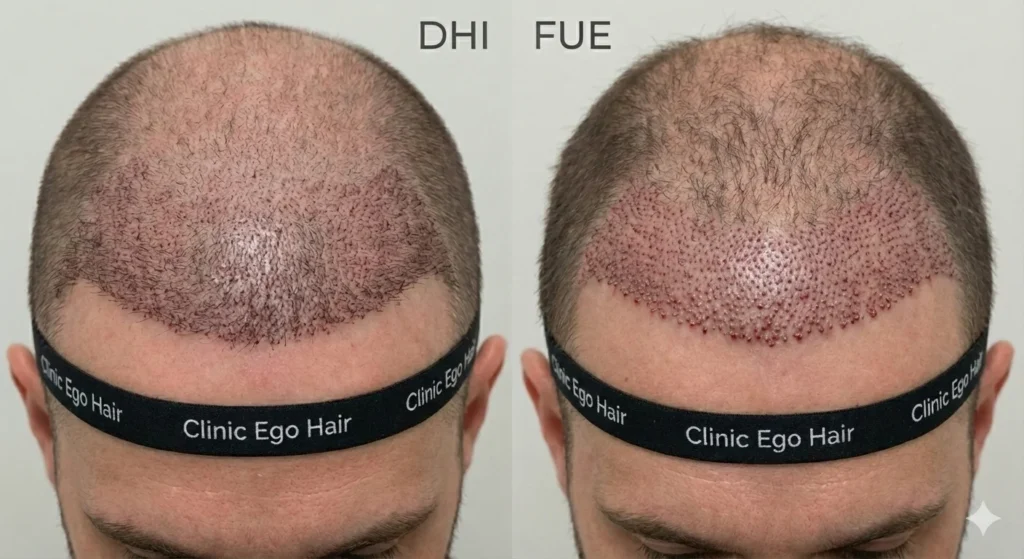
Understanding the difference between FUE vs DHI hair transplant is essential when deciding which method suits you best. Although both techniques use individual follicle extraction, their implantation approaches create meaningful differences.
| Feature | FUE Hair Transplant | DHI Hair Transplant |
|---|---|---|
| Extraction Method | Individual follicle extraction using a micro-punch | Individual follicle extraction (same as FUE) |
| Implantation Technique | Channels are opened first, then grafts are implanted | Grafts are implanted directly using the Choi Implant Pen |
| Channel Opening | Required before implantation | Not required |
| Hairline Precision | Natural results depend on channel design | Higher control over angle and direction |
| Density Control | Suitable for wide coverage | Ideal for high density in small areas |
| Shaving Requirement | Usually required | Partial or no-shave possible in some cases |
| Recovery Time | Standard recovery period | Often slightly faster in targeted areas |
| Suitable For | Large or advanced hair loss areas | Hairline-focused and detailed work |
| Procedure Duration | Shorter implantation phase | More time-intensive |
| Technique Complexity | Widely practiced | Requires highly trained specialists |
Technique Comparison
- FUE: Channels are opened first, then grafts are implanted
- DHI: Grafts are implanted directly using the Choi Pen
Hairline Precision
- FUE provides natural results, but precision depends on channel creation
- DHI allows greater control for detailed hairline design
Density and Coverage
- FUE is often preferred for covering large bald areas
- DHI is ideal for achieving high density in smaller or specific zones
Recovery Time
- Both methods have similar recovery timelines
- DHI may show slightly reduced redness in focused areas
Shaving Requirement
- FUE typically requires shaving the donor area
- DHI may allow partial or no-shave options in selected cases
FUE vs DHI Hair Transplant in Turkey
Turkey has become one of the leading destinations for hair transplantation due to its medical expertise, advanced clinics, and competitive pricing. When comparing FUE vs DHI hair transplant in Turkey, the decision often comes down to personal needs rather than cost alone.
Why Turkey?
- Experienced medical teams
- International treatment standards
- Advanced technology and facilities
- Personalized treatment planning
Choosing the Right Method in Turkey
Clinics in Turkey commonly offer both FUE vs DHI hair transplant, allowing patients to choose based on:
- Hair loss severity
- Desired hairline detail
- Donor area strength
- Lifestyle and recovery expectations
A professional consultation is crucial to determine the most suitable method rather than selecting based on trends or marketing claims.
DHI or FUE – Which Is Better?
One of the most common questions patients ask is: FUE vs DHI hair transplant, which is better?
The honest answer is that neither method is universally better—they serve different purposes.
FUE May Be Better If You:
- Have advanced or widespread hair loss
- Need a large number of grafts
- Prefer a well-established, versatile method
- Want the option of Sapphire FUE as an upgrade
DHI May Be Better If You:
- Want highly detailed hairline work
- Need high density in small areas
- Have limited hair loss
- Prefer minimal scalp trauma during implantation
Which Hair Transplant Method Is Right for You?
Hair Loss Pattern Matters
Patients with extensive hair loss often benefit more from FUE, while those with localized thinning or a receding hairline may achieve better results with DHI.
Expectations and Lifestyle
If your priority is maximum density and refined design, DHI may be the right choice. If coverage and efficiency are more important, FUE may be a more suitable option.
Surgeon Experience Is Key
Regardless of method, results depend heavily on:
- Medical expertise
- Proper planning
- Ethical graft distribution
The best outcomes come from choosing the right clinic, not just the technique.
Final Thoughts
Both FUE and DHI hair transplant methods are effective, safe, and capable of delivering natural-looking, permanent results when performed by experienced professionals.
Instead of asking which method is better in general, the more important question is:
Which method is better for you?
A personalized consultation that considers your hair type, donor area, and goals will always lead to better results than choosing a technique based on popularity alone.
Frequently Asked Questions Summary
Is DHI more advanced than FUE?
DHI is considered a more specialized implantation technique, but not necessarily superior in all cases.
Can FUE and DHI be combined?
Yes, in some advanced cases, hybrid approaches may be recommended.
Are the results permanent with both methods?
Yes, transplanted hair is generally permanent when proper medical protocols are followed.